/Logo%202023%20final%20dunkelgrau.png?width=221&height=97&name=Logo%202023%20final%20dunkelgrau.png)




















Dashboards are often the final step in a long data pipeline and at the same time the part that business units, management and end users perceive the most. This is where it becomes clear whether data turns into clear, trustworthy business insights or whether discussions about numbers, definitions and discrepancies overshadow the actual value.
In data-driven organizations, this is a central challenge:
Different dashboards show different values for the same KPI. KPI logic is duplicated across reports and continuously modified. With every new analysis, the risk of inconsistent business decisions increases.
With AI/BI Dashboards in Databricks and the introduction of Metric Views, Databricks addresses exactly this issue. Dashboards are no longer just visualization layers. They become part of a semantically clean, governance-driven analytics stack. Metrics are centrally defined, versioned, and controlled, and then used consistently across dashboards, reports, and AI-powered queries.
In this blog post, we will look at:
-
how dashboards are structured in Databricks today
-
which innovations have significantly advanced the AI/BI ecosystem over the past year
-
why Metric Views are the key to consistent business KPIs
We also recommend our blog post “Enterprise Databricks vs. SAP Databricks: Everything you need to know”. In that article, we explain the differences between the Enterprise version of Databricks and SAP Databricks and outline which option fits which strategic requirements.
The Most Important Innovations in the Databricks Dashboard Ecosystem
The following points highlight a selection of the most relevant and practical innovations. The AI/BI ecosystem around Databricks is evolving rapidly - many additional features are available or currently in preview.
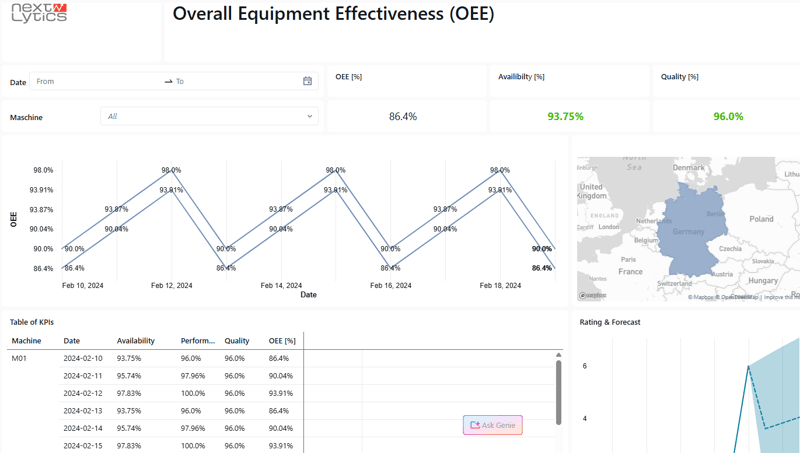
Modern BI – many familiar features, natively in the lakehouse
Many features known from established BI tools are now directly integrated into Databricks Dashboards:
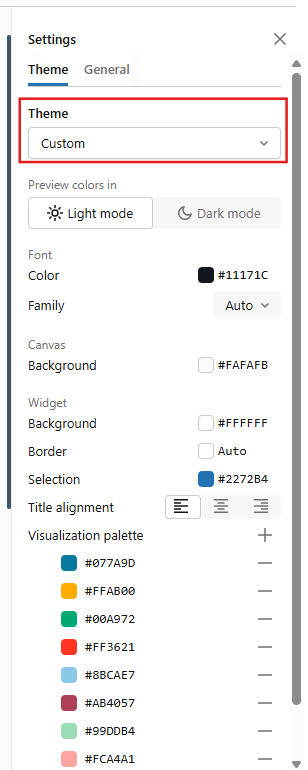
Theme Customization
Dashboards can be designed according to corporate branding - including colors, layout standards and consistent visualization styles. A widely appreciated dark mode is also available.
Practical example:
A central BI team defines a standard theme so that all departments create dashboards that are immediately recognizable company-wide.
Global Dashboard Filters
Filters can operate across multiple pages or allow visualizations to dynamically interact with each other. Pivot tables now support cross-filtering: users can click directly on values within the pivot table, automatically filtering other visualizations on the dashboard. This makes analysis significantly more interactive and enables intuitive navigation across multidimensional data.
Drill-Through Navigation
Users can jump directly from a KPI to detailed analysis - including inherited filter context.
Forecasting in Line Charts
AI-powered forecasting can now be integrated directly into time series visualizations.
Watch the recording of our Webinar:
"Bridging Business and Analytics: The Plug-and-Play Future of Data Platforms"

Security & Governance – Built-In by Design
A key difference compared to traditional BI architectures lies in the end-to-end governance integration. In classic setups, security logic often has to be replicated separately inside the BI tool. Databricks Dashboards instead access data governed centrally in the Unity Catalog.
This means:
-
Row-Level Security (RLS) is defined directly at table or view level
-
Column-Level Security (CLS) protects sensitive columns such as margins, HR data, or confidential KPIs
-
Role and permission models remain consistent across SQL, dashboards, AI queries, and data pipelines
Technically, permissions are not modeled in the dashboard itself but in the central metadata and governance layer. Dashboards automatically inherit this logic.
This reduces:
-
redundant security configurations
-
inconsistencies between reports
-
the risk of unintended data exposure
Access to Databricks is not licensed per dashboard viewer in the traditional BI sense, allowing dashboards to be shared broadly at comparatively low cost.
Collaboration & Distribution – Dashboards as Operational Tools
Modern dashboards are not just analytical interfaces - they are central communication and steering instruments.
Databricks supports this on multiple levels:
Sharing & Integration
A dashboard creates real value only when it is available where decisions are made. Databricks offers flexible options for this.
• Secure Sharing
Dashboards can be shared with individual users or groups, including role-based access control. Lakehouse-defined Row-Level and Column-Level Security rules remain enforced. Even when shared, each user only sees the data they are authorized to access.
• iFrame Integration
For many organizations, it is essential that dashboards are not consumed in isolation but embedded into existing systems — such as intranets, business portals, or internal applications.
Through iFrame compatibility, Databricks dashboards can be embedded into these environments without duplicating data or introducing additional reporting tools.
Schedule & Subscriptions
Dashboards can be executed on a schedule and distributed automatically. Not every user actively logs into dashboards, so automation plays a critical role.

• Scheduled Execution
Dashboards can refresh at defined intervals - daily, weekly, or monthly - ensuring regular and automated reporting.
• Email Distribution with Embedded Visualizations
Subscribers receive automated emails containing embedded visualizations. Executives can view key KPIs directly in their inbox without additional login steps.
• Publishing to Microsoft Teams Channels
In many organizations, Microsoft Teams serves as the central communication platform. Dashboards or scheduled reports can be automatically published into Teams channels to improve transparency and collaboration.
Metric Views – The Semantic Foundation of Consistent Dashboards
With all the new dashboarding capabilities, one central question arises:
“How do we ensure that every KPI is calculated exactly the same way across every dashboard - regardless of who built it?”
This is precisely where we believe Metric Views can help.
Metric Views in Databricks form a semantic layer on top of your data. They centrally define business KPIs, document their logic, and make them reusable across the organization. Instead of reimplementing calculations in each dashboard, the business definition is modeled once and then reused everywhere. 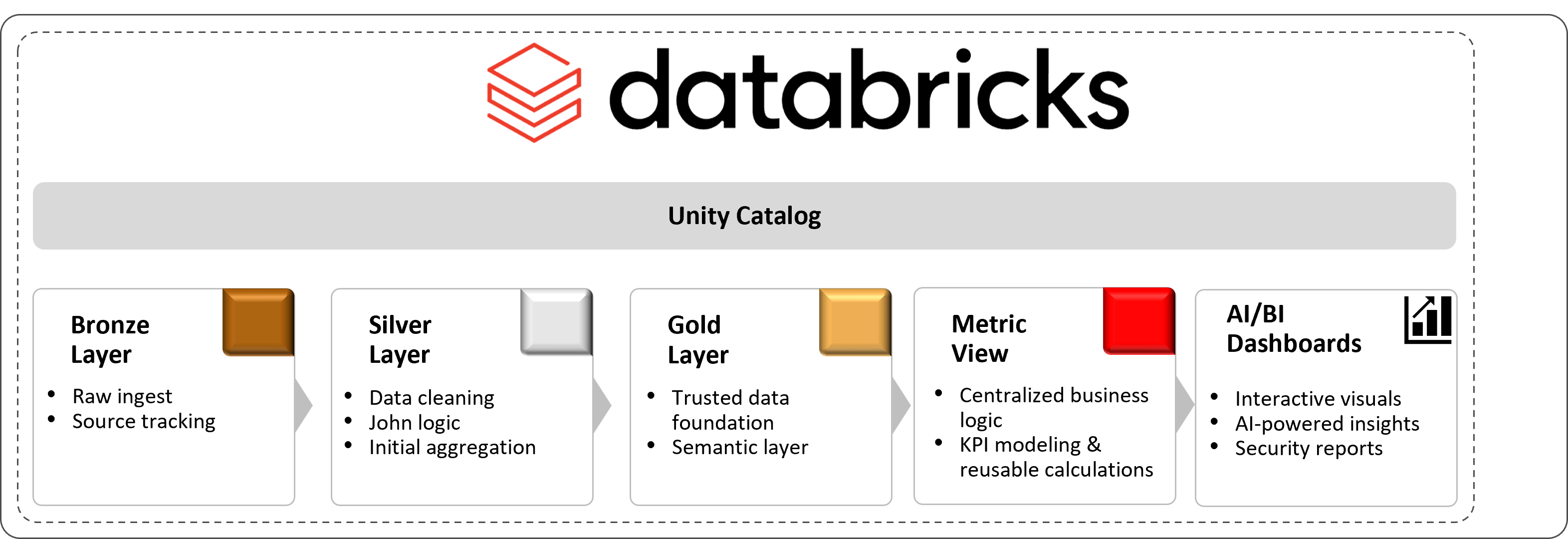
With more complex KPIs, incorrect aggregation can quickly lead to inconsistent results. For example, averaging an already aggregated value or calculating ratios at the wrong granularity may technically “work” — but produce incorrect business insights.
Metric Views explicitly define:
-
which aggregation function is valid
-
at which granularity a metric must be calculated
-
with which dimensions it may be meaningfully combined
This prevents KPIs from being calculated at incorrect levels within dashboards. The semantic logic no longer resides in the visualization tool but in a controlled, centralized layer.
You can think of Metric Views as a binding KPI contract between the data team and the business.
From a performance perspective, queries become more structured and targeted. Instead of scanning entire fact tables with all columns and performing ad hoc calculations in dashboards, the engine accesses clearly defined metrics.
Technically, this means:
-
only required columns are processed
-
only relevant granularities are queried
Databricks One – the Entry Point for Business Users
After discussing dashboards and the importance of Metric Views, the next question is:
“For whom are these dashboards intended - and how are they consumed?”
This is where Databricks One comes into play.
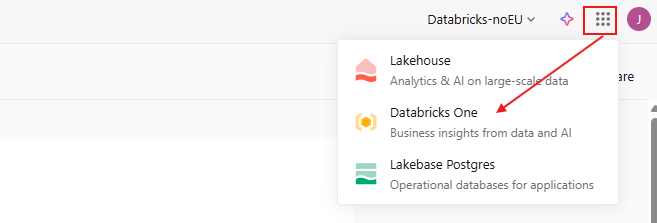
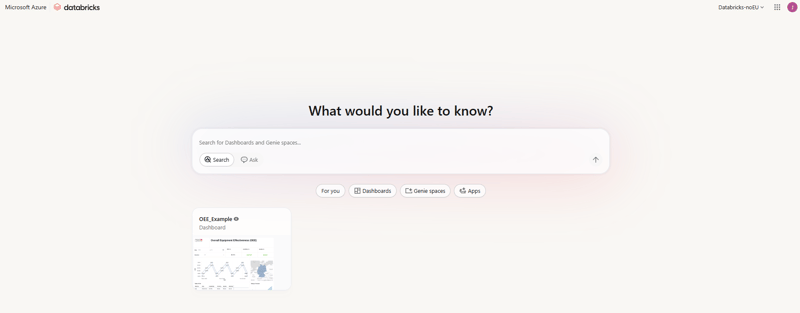
Databricks One is a new business-oriented interface designed to make Databricks accessible to non-technical users. Instead of entering a technical workspace with clusters, notebooks, or SQL editors, users receive a simplified and intuitive entry point to interact with data and AI tools.
Many business users feel overwhelmed by traditional data platform interfaces because they contain technical concepts irrelevant to their daily work. Databricks One closes this gap:
-
it centralizes analytics, dashboards, and AI interactions in one place
-
it removes technical complexity so users immediately focus on insights
The interface is intentionally slim and focused. After login, users see only what is relevant to them - enabling immediate value-driven analysis.
Conclusion – our perspective on modern Dashboarding in Databricks
We are convinced: The greatest value does not come from a single feature but from the interaction of components on one platform.
With Databricks, we see a clear architectural advantage:
Data, governance, KPI logic, dashboards, and AI-driven analytics are seamlessly integrated — without tool breaks, duplicate security logic, or parallel semantic layers.
From our perspective, the key advantages lie in four areas:
1. Everything in one platform
Dashboards access the Lakehouse directly, while governance and security logic are centrally managed. Different user interfaces - from the technical workspace to Databricks One - serve distinct user groups without fragmenting the architecture or introducing additional system complexity.
2. Business logic belongs in Metric Views
KPI definitions are often distributed across BI frontends. Metric Views centralize and standardize them. This increases consistency, reduces discussions about numbers, and builds trust. Especially when AI functions or natural language queries are involved.
3. Low code is often sufficient
Not every user is a data engineer nor should they be expected to be. Visual dashboard creation and simplified interfaces empower business teams to validate analytics independently.
With Databricks One, Databricks takes it a step further:
Management and business users are provided with a deliberately streamlined and focused interface. No technical menus, no notebook structures, no unnecessary complexity, just clear access to dashboards, KPIs, and AI-powered analytics.
We see this as a critical success factor:
Executives can fully concentrate on insights and decision-making, while data and governance logic remain cleanly centralized in the background.
4. Governance is integral, not an add-on
Row-Level and Column-Level Security are enforced directly in the Lakehouse - not in the frontend. This ensures consistency, auditability, and compliance.
At the same time, we are realistic:
In practice, BI and IT architectures rarely rely on a single tool. Most organizations operate multiple ERP systems, DWH approaches, and frontend tools. Databricks does not necessarily replace everything - it often acts as a strategic and integrative component within a broader data strategy.
Our approach is not “replace tools at any cost,” but to evaluate together:
-
Where does Databricks create real value?
-
Where does it simplify architecture and governance?
-
Where can dashboarding be consolidated or AI meaningfully integrated?
If you are asking yourself how Databricks dashboarding or Databricks in general fits into your existing data strategy, feel free to reach out. We are happy to support you in designing a realistic and sustainable target architecture.