/Logo%202023%20final%20dunkelgrau.png?width=221&height=97&name=Logo%202023%20final%20dunkelgrau.png)




















2025 was a landmark year for SAP Datasphere. The release of SAP Business Data Cloud (BDC) set a new strategic direction for SAP’s data portfolio, positioning Datasphere as a central component in a modern data architecture. Revolving around the introduction of a common object store that supports bidirectional, zero-copy data exchange with a growing ecosystem of partnerships like Databricks, Snowflake, Microsoft Fabric and Google BigQuery, this year significantly strengthened SAP Datasphere’s position in the data platform market.
In case you are new to the topic, have a look into our Blog-Series on Business Data Cloud (BDC).
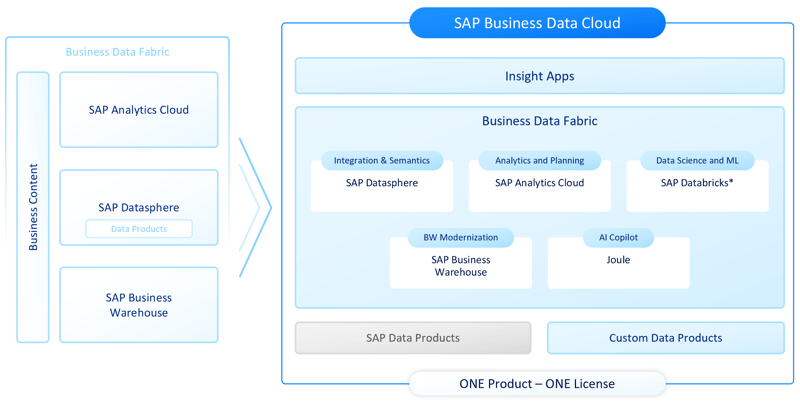
Today we want to take a deeper look at SAP Datasphere specifically and at the most significant additional features it received in 2025 before taking a brief look ahead at what is to come in 2026 and beyond.
Data Integration
It is clear that SAP focused primarily on Replication Flows this year. This area received the most development attention, effectively filling the gaps that existed when the tool was first launched.
The updates to Replication Flows cover many areas. Connectivity increased with new sources including Microsoft OneLake, Microsoft SQL Server, and SFTP (now supported as both source and target), as well as SQL Views. Usability also improved, adding features such as the ability to reuse source objects across multiple flows and email notifications for object failures. Recently the maximum parallel jobs have been increased as well. Notably we were not able to explore the newest promising addition in enough detail yet: Replication of ODP sources with load type initial+delta without primary keys. This could prove very useful for integrating legacy SAP ECC systems.
Replication Flows have improved quite a lot since their introduction. They now cover most sources that previously required SDI (Smart Data Integration) for automatic Delta/CDC, and they handle unique sources not supported by other object types. Stability and enterprise readiness have also improved by a lot. However in practice we still have some concerns:
1. Monitoring is still difficult in some cases. Specific replication errors (especially with S/4HANA) are not always clear at a glance.
2. There is a need for Delta Load Timing control. Currently, you cannot control exactly when delta loads run, which is a severe limitation to a lot of architectural designs.
In comparison, updates to other Flow objects were smaller in scope. Transformation Flows gained capabilities like PlanViz generation for performance simulation and batch processing to prevent Out-Of-Memory errors. Data Flows received nothing of note.
As expected, Data Flows seem to remain as a support tool for legacy connections not yet handled by Replication Flows. Regarding Transformation Flows, we are still hoping for more flexible delta handling logic to support complex scenarios in the future.
Task Chains received various updates, including deep retry capabilities, 5-minute scheduling increments, and layout controls. The most important feature is the connection to external systems via generic HTTP and consequently running API tasks in Task Chains, being able to trigger external RestAPIs. This allows flexible integration into your broader system landscape and orchestration.
Fun Sidenote: One of our requested features from 2024, support for input parameters in Task Chains, was also added this year. While we originally asked for this in combination with Data Flows, SAP implemented it for Transformation Flows instead, matching their strategic direction.
Watch the recording of our webinar:
"SAP Datasphere and the Databricks Lakehouse Approach"
Data Modeling
For data modeling the focus this year was clearly on the Analytic Model. Updates included the ability to stack analytic models (using one model as a source for another), replace fact sources more easily, and improved impact and lineage analysis including measures. We also saw practical additions like direct formatting of decimal places, and a dedicated Fiscal Time dimension.
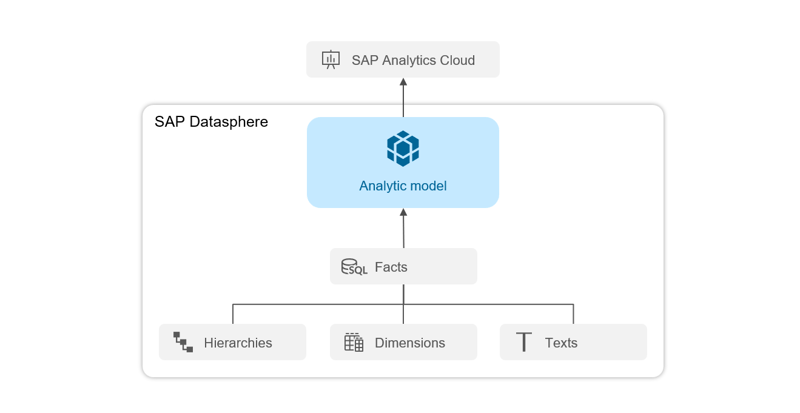
When talking about Analytic Models, inevitably we need to talk about BW feature parity. The most crucial gaps for users between the two systems are usually found when comparing SAP BW Queries with the SAP Datasphere Analytic Model (AM).
To bridge part of this gap SAP finally added the ability to create structures within analytic models, allowing for restrictions and calculations across all measures of an AM. While this is a good start and necessary foundation for further development, this initial release was more limited than many users expected. We hope SAP will deliver the remaining functionalities, such as the grouping and sequencing of structure members, in the near future.
The other major addition from early in the year was Object Versioning. This allows developers to open and restore specific versions of views, analytic models, and other objects. This is an immense improvement for the day-to-day work of developers and a necessity for the enterprise readiness of the platform, providing a safety net when making changes. While we are still looking forward to full Git integration in the future, versioning serves as a necessary bridge until full integration arrives.
Additional Notable Areas
Artificial Intelligence
SAP frequently discusses AI, but the actual features currently available on Datasphere does not yet match the amount of attention the topic receives. It seems SAP is still searching for ways to integrate AI effectively.
Currently, users can enrich data catalog assets by automatically generating summaries, descriptions, and tag relationships. Another feature can generate semantics, helping developers by suggesting semantic usage types for entities and identifying measures and attributes.
A significant drawback right now is the licensing model. Using these features requires a separate subscription for AI units. This creates a barrier for many users who might otherwise try these tools. We hope SAP removes this cumbersome process soon to encourage wider adoption.
Object Store
The Object Store (space) became generally available in April this year, following a restricted release in December 2024. Throughout the year, SAP added some fundamentally missing features, including the ability to transport developments across tenants. The Object Store is now ready for its intended role as the core ingestion layer for the Business Data Cloud. It serves as the necessary foundation for the platform's "zero-copy" architectural approach.
A recent update closed a major gap: the ability to load data from a regular HANA space into the Object Store (space). Previously, the zero-copy ecosystem was limited to source systems that Replication Flows could support directly within the Object Store space. Now, data can move from a standard HANA space into the Object Store. This change makes a much wider range of source systems available for zero-copy integration, significantly increasing the utility.
Looking forward to 2026
As we look ahead to 2026, we expect SAP to shift its focus even more heavily towards Business Data Cloud (BDC) and build SAP Datasphere features to facilitate the associated ecosystem.
A major part of this shift will likely be the Data Product Studio, which SAP has teased frequently over the last year. We expect this tool to change how developers create and manage data assets. Instead of handling raw tables or views, the Studio should allow users to bundle data and metadata into standardized "products" that are easier for business users to find and consume.
We also anticipate an increase in pre-built data products coming directly from operational systems like SAP S/4HANA. Alongside these, we expect to see more SAP-managed Insight Apps. These applications aim to combine pre-build data models, visualizations and logic, helping quick-start reporting solutions as well as reducing costs for maintaining these solutions.
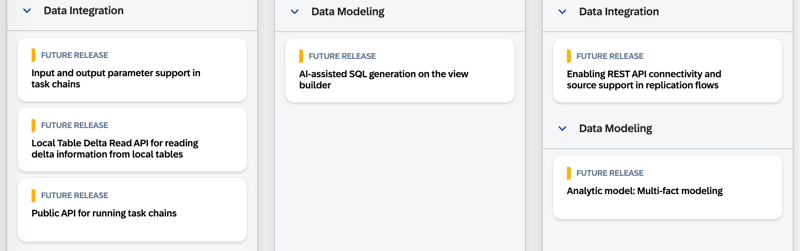
We leave you with a list of the top roadmap items we are watching for in 2026. Let’s review this list next year to see how they panned out:
What was your top feature of 2025? Which features are you most looking forward to in 2026?
Should have any questions or what to discuss how SAP Datasphere can contribute to your business, book a non- binding consultation with one of our experts.