Skip to content
NextLytics
Megamenü_2023_Über-uns

Shaping Business Intelligence

Whether clever add-on products for SAP BI, development of meaningful dashboards or implementation of AI-based applications - we shape the future of Business Intelligence together with you. 

Megamenü_2023_Über-uns_1

About us

As a partner with deep process know-how, knowledge of the latest SAP technologies as well as high social competence and many years of project experience, we shape the future of Business Intelligence in your company too.

Megamenü_2023_Methodik

Our Methodology

The mixture of classic waterfall model and agile methodology guarantees our projects a high level of efficiency and satisfaction on both sides. Learn more about our project approach.

Products
Megamenü_2023_NextTables

NextTables

Edit data in SAP BW out of the box: NextTables makes editing tables easier, faster and more intuitive, whether you use SAP BW on HANA, SAP S/4HANA or SAP BW 4/HANA.

Megamenü_2023_Connector

NextLytics Connectors

The increasing automation of processes requires the connectivity of IT systems. NextLytics Connectors allow you to connect your SAP ecosystem with various open-source technologies.

IT-Services
Megamenü_2023_Data-Science

Data Science & Engineering

Ready for the future? As a strong partner, we will support you in the design, implementation and optimization of your AI application.

Megamenü_2023_Planning

SAP Planning

We design new planning applications using SAP BPC Embedded, IP or SAC Planning which create added value for your company.

Megamenü_2023_Dashboarding

Business Intelligence

We help you with our expertise to create meaningful dashboards based on Tableau, Power BI, SAP Analytics Cloud or SAP Lumira. 

Megamenü_2023_Data-Warehouse-1

SAP Data Warehouse

Are you planning a migration to SAP HANA? We show you the challenges and which advantages a migration provides.

Business Analytics
Megamenü_2023_Procurement

Procurement Analytics

Transparent and valid figures are important, especially in companies with a decentralized structure. SAP Procurement Analytics allows you to evaluate SAP ERP data in SAP BI.

Megamenü_2023_Reporting

SAP HR Reporting & Analytics

With our standard model for reporting from SAP HCM with SAP BW, you accelerate business activities and make data from various systems available centrally and validly.

Megamenü_2023_Dataquality

Data Quality Management

In times of Big Data and IoT, maintaining high data quality is of the utmost importance. With our Data Quality Management (DQM) solution, you always keep the overview.

Career
Megamenü_2023_Karriere-2b

Working at NextLytics

If you would like to work with pleasure and don't want to miss out on your professional and personal development, we are the right choice for you!

Megamenü_2023_Karriere-1

Senior

Time for a change? Take your next professional step and work with us to shape innovation and growth in an exciting business environment!

Megamenü_2023_Karriere-5

Junior

Enough of grey theory - time to get to know the colourful reality! Start your working life with us and enjoy your work with interesting projects.

Megamenü_2023_Karriere-4-1

Students

You don't just want to study theory, but also want to experience it in practice? Check out theory and practice with us and experience where the differences are made.

Megamenü_2023_Karriere-3

Jobs

You can find all open vacancies here. Look around and submit your application - we look forward to it! If there is no matching position, please send us your unsolicited application.

Blog
NextLytics Newsletter
Subscribe for our monthly newsletter:
Sign up for newsletter
 

Agentic AI in Data & Analytics

How AI Agents change how we work with Data Platforms

A chatbot answers questions; a copilot makes suggestions that a human then acts on. An AI agent takes it one crucial step further. It plans multi-step tasks, independently selects tools, executes them within the system, and continues working until the goal is achieved. An open standard makes this possible. The Model Context Protocol (MCP) connects AI assistants with running systems, a kind of universal adapter for AI tools and has been under cross-vendor development since late 2025 under the umbrella of the Linux Foundation. Data and analytics is an ideal field for this, as it features structured metadata, clear interfaces, and a notoriously high level of effort required for analysis, development and operations.

Agentic AI in Data & Analytics

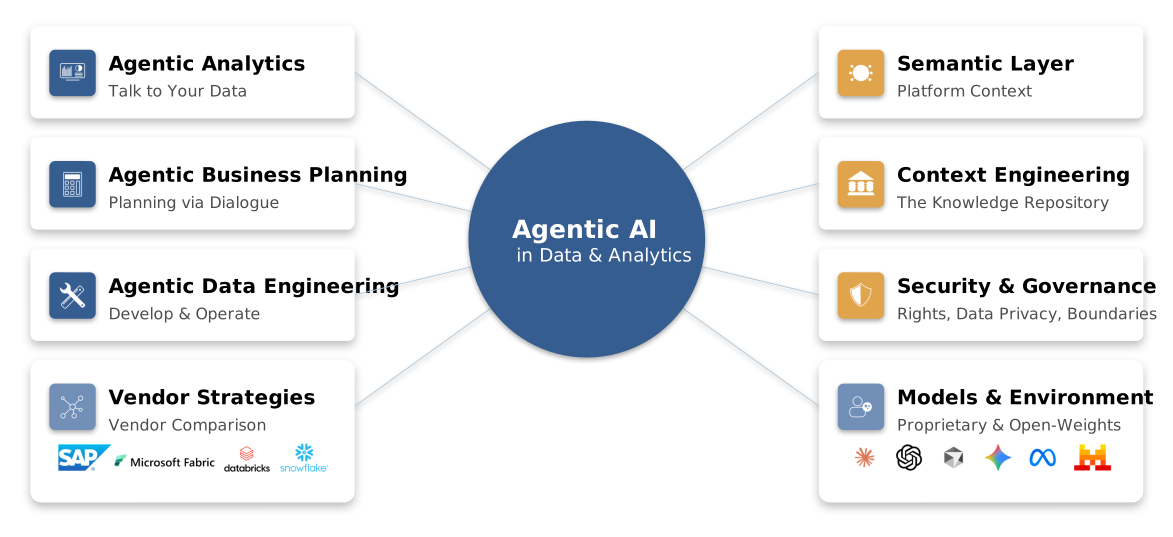
What this means in concrete terms becomes apparent on several levels. Users gain access to their data through natural language; corporate planning can be managed through dialogue; and the development and operation of data platforms are also becoming increasingly agent-driven. The extent to which this applies depends on the strategy the vendor pursues and how open it is to allowing agents into its systems. SAP takes a different approach here than pure data platforms. It also depends on the models and environment you’re working with, as well as on a security and governance framework that holds up in production environments. Above all, however, it is the context an agent is given and how that context is organized, that matters most. After all, in the end, success or failure is rarely determined by the model or the tools alone.

Agentic AI in Data & Analytics – overview of topics

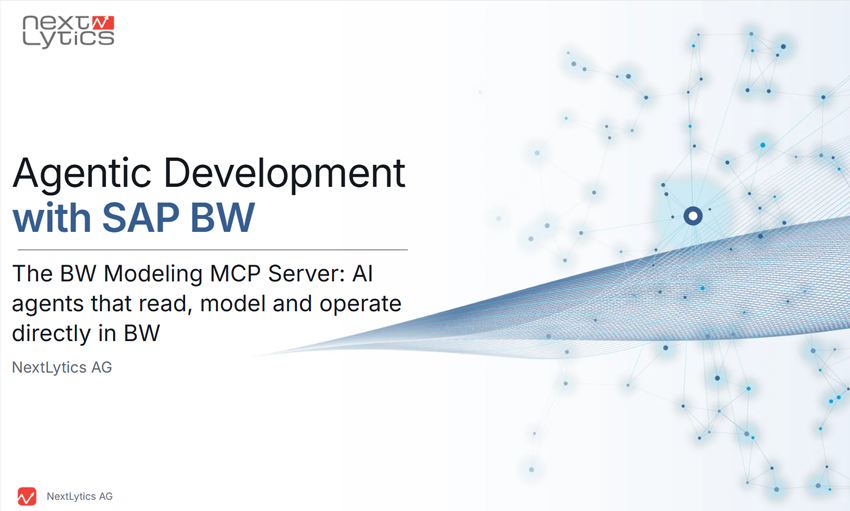
Presentation: Agentic Development with SAP BW

Download Presentation: Agentic Development with SAP BW 

AI agents that directly read, model, and operate inside SAP BW. Download our presentation to discover how the BW Modeling MCP Server automates complex tasks—from reconstructing ABAP customer exit logic to AI-supported migration to SAP Datasphere.

What AI Agents in Data Platforms are capable of today

Agentic AI in Data & Analytics is not a single feature, but rather a set of capabilities. Three of these are particularly prominent in practice today.

Agentic Analytics - Let the Data Speak

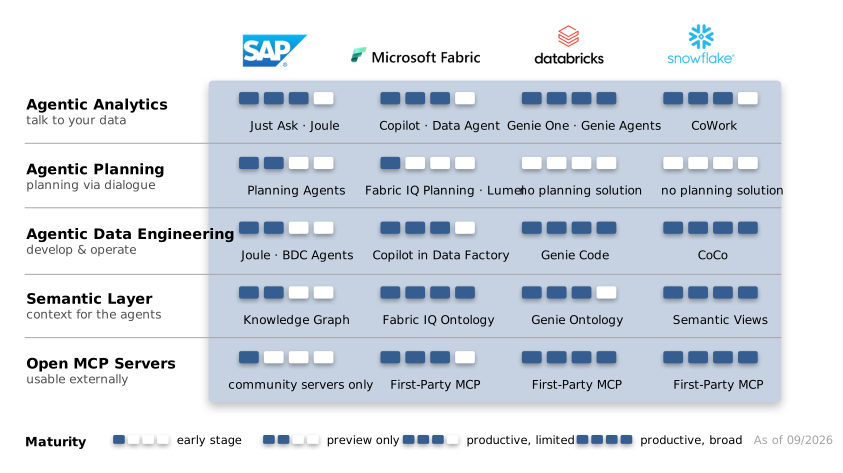
Instead of preparing a report, you ask a question in natural language for example, about the five top-selling products each month. The agent selects the appropriate data source from the approved ones, aggregates the data, and responds immediately - even if no report exists for that query yet. All major platforms now support this basic query functionality in production in the SAP Analytics Cloud with “Just Ask” and “Joule,” and on data platforms such as “Genie One” from Databricks or “CoWork” from Snowflake. More exciting is the next level up: generating entire analyses and dashboards via prompts. Here, vendors vary in the scope of their capabilities, ranging from individual report pages as a starting point to complete dashboards, including the import of existing reports from other tools.

Agentic Business Planning - Planning Through Dialogue

Closely related to this and one of the most exciting capabilities for us, is agentic planning. This refers to working with a plan via prompts, changing assumptions, running scenarios and entering plan values through dialogue, without having to click through forms. Taking this concept a step further is the idea of designing the planning application itself using natural language, rather than modeling it in the traditional way.

SAP has the deepest context here, as planning has been part of the analytics stack since the days of BW and remains so in the SAP Analytics Cloud to this day. The roadmap includes several specialized planning agents that work directly with the SAP Analytics Cloud’s planning models, ranging from the Conversational Planning Agent, which changes plan values via prompts, to the Model Creation Agent, which builds planning models itself. Much of this is still in the announcement phase. The data platforms have little to offer in this area. Microsoft is introducing Planning in Fabric, a full-fledged planning application though it is not yet agent-driven while Databricks and Snowflake lack native planning solutions.

This means SAP retains its lead in this capability, even if it currently consists largely of announcements and testing. And this lead is not unchallenged; specialized planning providers are already focusing on the integration of large language models.

Agentic Data Engineering -Developing and Operating Data Platforms

The third capability picks up where IT development has traditionally ended. An agent analyzes existing data models, explains accumulated logic in plain language, creates new objects and data flows, and accelerates migrations, all within the actual system and using the same interfaces as native development tools. This is already standard practice for data platforms; Databricks with Genie Code and Snowflake with CoCo provide agent-based development environments that plan, execute, and debug code. At SAP, Joule has been integrated into SAP Datasphere, but so far it has primarily supported search and catalog maintenance. Agent-based development, in which Joule itself creates models and data flows, does not yet exist.

All of this takes place in the cloud. The many SAP customers who continue to run their data warehouses with BW 7.5 on HANA or BW/4HANA on-premises have so far been left out of agent-driven development. That is precisely why we developed the BW Modeling MCP Server as an open-source project. It connects AI assistants to a running BW system so that they can analyze data models, create objects and build data flows there as well.

And it doesn’t stop at building. Increasingly, the focus is shifting toward agent-driven operations: platforms that optimize themselves, pipelines that detect and fix errors, and loading processes that are monitored and adjusted. At the infrastructure level, this is already a reality for data platforms. A data platform that is completely self-managing does not yet exist, but the direction is clear. The current limit lies where an agent would intervene in production objects without human approval and it is precisely this approval that is still deliberately built into today’s tools.

SAP and Data Platforms: Two Different Worlds

Those who implement Agentic AI in their data landscape will encounter two fundamentally different strategies. The chart summarizes where the four major providers stand today. The real difference, however, lies not in individual levels of maturity, but in their approach.

Agentic AI maturity by vendor: SAP, Microsoft Fabric, Databricks, Snowflake
Background1_small
SAP_logo

SAP approaches analytics and planning from an ERP perspective. This provides agents with deep process context right at their fingertips, since the business semantics are already embedded in the suite’s models, and it explains SAP’s lead in planning. At the same time, SAP wants to establish itself as the primary agent-based environment. Joule is intended to become the place where SAP data is processed. This aligns with the fact that SAP does not provide its own MCP server for SAP BW/4HANA, SAP Datasphere, SAP Business Data Cloud, and SAP Analytics Cloud. Anyone who wants to work with these systems from a different agent-based environment must rely on open-source servers from the community that use existing and in some cases undocumented interfaces, with all that this entails for support and governance.

Background3_small
Transparent Fabric Logo
pngwing.com (1)
Snowflake_Logo.svg

The data platforms Microsoft Fabric, Databricks, and Snowflake start from the data. They are more advanced in terms of agent-based development and they provide official MCP servers as part of the product documented, supported and secured through the platform’s permissions. Any MCP-enabled environment can connect and the platform’s semantic layer moves along with it. However, they lack the process context of ERP and planning is not a feature they support.

For an IT manager with a hybrid environment, this offers some peace of mind. He doesn’t have to choose one world over another. Joule is one option - not the only one - and the open connectivity that comes with the data platforms is available for SAP systems from the community, including from us. Because all providers rely on the same open standard, choosing a platform is no longer an irreversible commitment. What carries weight across platforms is the way of working.

Model and environment: how to steer the agents

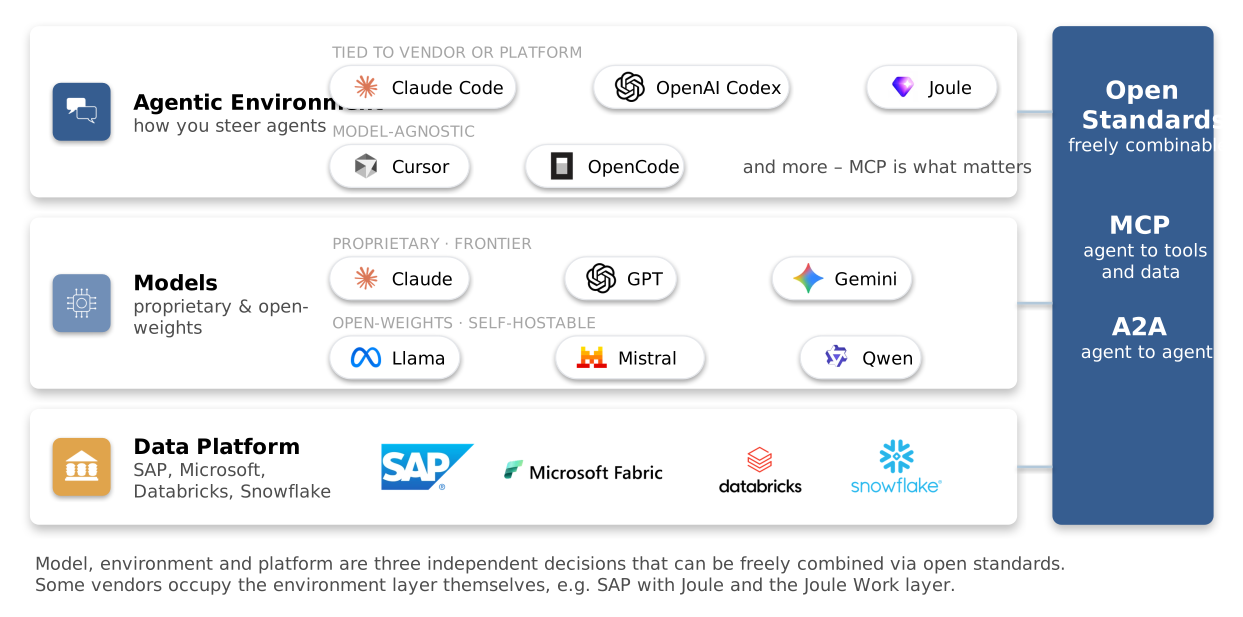
Above the platforms lies a second layer: the models and the agent-based environment used to control the agents. Today, the model, environment and platform are three independent decisions that can be freely combined using open standards. Some environments are tied to a specific model provider, such as Claude Code or OpenAI Codex, while others are tied to a specific platform, such as Joule at SAP, Genie One at Databricks, CoWork at Snowflake, or Microsoft 365 Copilot. Still others are model-agnostic, such as Cursor or OpenCode. The list is constantly growing; what matters is whether an environment supports open standards such as MCP and skills.

Agentic environment, models and data platform combined via open standards (MCP, A2A)

Open-weight models have also caught up. Leading open-weight models now perform nearly as well as top-tier proprietary models and can be run independently using published weights. In practice, the choice rarely comes down to a single model; agent-based systems distribute tasks across multiple models and select the most appropriate one based on requirements and costs.

When it comes to the environment, a real question arises, because every vendor offers its own and makes the same argument: their own agent understands the platform’s context without configuration, whereas a third-party agent running via MCP does not. There is a grain of truth to this objection: an agent that uses MCP merely to execute SQL queries against raw tables delivers poor results, regardless of where it runs. However, this does not apply to the open approach as such, because the manufacturers’ MCP servers handle the semantic layer as long as their semantic tools are used. What a proprietary environment, on the other hand, cannot provide is context beyond its own platform, and in heterogeneous environments, it ends at every system boundary. Which environment is used therefore helps determine what an agent is allowed to do and which systems it can access.

Context - what really matters

An agent that requires you to explain again with every task what a table means, how a metric is calculated and how two entities are related will produce inconsistent results. An agent relies on existing structure; it cannot create it on its own. Gartner expects universal semantic layers to be treated as critical infrastructure by 2030, alongside data platforms and cybersecurity, and predicts that by 2027, organizations that prioritize semantics in AI-ready data will increase their agentic AI accuracy by up to 80 percent.*

The platforms themselves provide the first part of this context. Their semantic layer describes entities, relationships, metrics, synonyms and the permissions associated with them - in SAP’s Knowledge Graph and the Business Data Cloud’s data products; in Microsoft’s Fabric IQ and the Power BI semantic model; in Databricks’ Genie Ontology; and in Snowflake’s Semantic Views. All four place this layer at the center of their strategy and all four are working to derive parts of it from existing dashboards, queries, and usage patterns rather than simply modeling it. For an agent, this means they know what revenue means, how the fiscal year is structured and what they’re authorized to view. Through MCP, an external agent receives the same context as an in-house agent.

However, there are two things this layer cannot do. It is familiar only with its own platform and it knows only what can be derived from data and metadata. The second part of the context isn’t found in any system. Organizational responsibilities, rule sets, naming conventions, knowledge from ongoing projects, new requirements from the business unit, the organization’s own strategy, the reasons behind decisions that have evolved over time and the connections between systems that are unaware of one another. In a typical landscape, for example, the data resides in BW or Datasphere, the requirements are in Jira, the conventions are in the wiki, and the process knowledge is in the minds of the business department. Without this part, an agent is dangerously good. It delivers results that look clean, are technically correct and yet miss the mark the column with a name different from all its neighbors, the model that no one familiar with the project would have built that way. Each of these changes seems reasonable on its own. Together, however, they create inconsistencies at a rate no team of humans could ever have achieved.

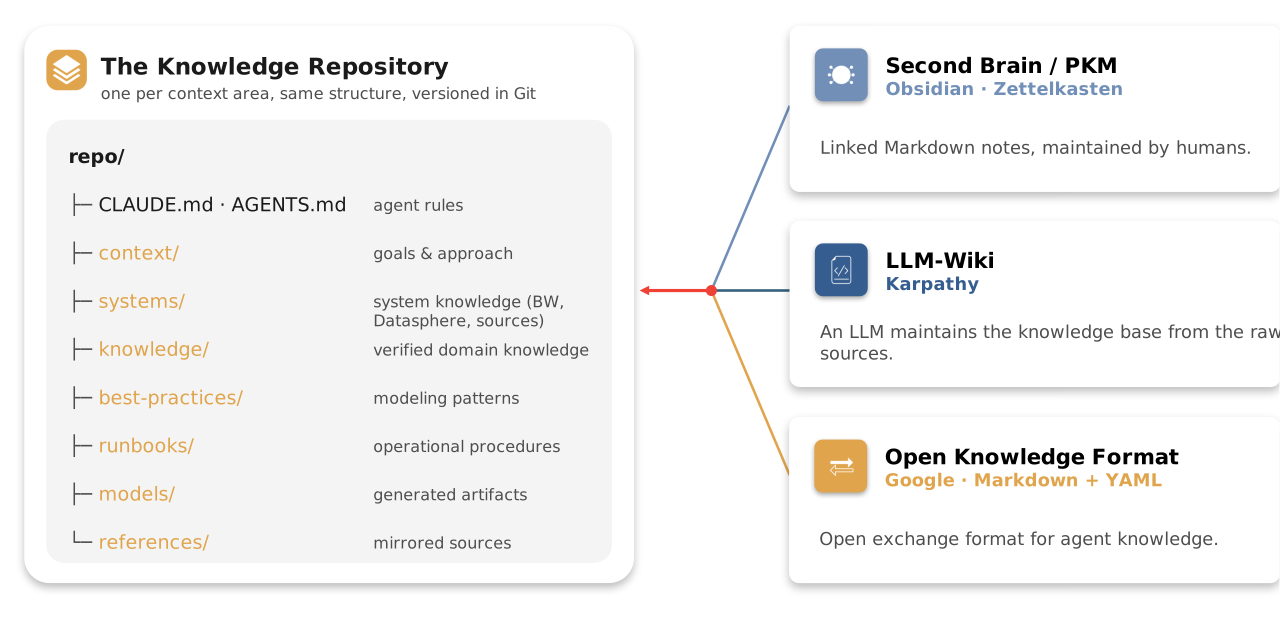
Context engineering is the discipline that organizes precisely this context and makes it permanently available. If prompt engineering is like drafting a single letter, then context engineering is like setting up an entire office. In practice, this results in a version-controlled knowledge repository for each context area that serves both humans and agents alike. Markdown in Git, clearly structured, with rules for the agents, a notation indicating which knowledge is verified and which is not, and with the orchestration of the MCP servers, which make the systems, including their semantic layer, accessible to the agent. No one came up with this pattern on their own. Several strands converge on this, ranging from personal knowledge management to a wiki maintained by a language model, all the way to Google’s Open Knowledge Format, which - since June 2026 - has proposed Markdown with structured metadata as an open specification specifically for this purpose. Setting up such a repository properly, clearly structured, reliably maintained and with the right rules for the agents, is the real art. This is precisely the expertise we bring from our projects, vendor-neutral and across all platforms.

* Gartner, "Gartner Announces Top Predictions for Data and Analytics in 2026", press release, March 11, 2026, and Gartner, "Gartner Says Lack of Semantics Causes Inaccurate AI Agents and Wasted Spending", press release, May 11, 2026. GARTNER is a registered trademark of Gartner, Inc. and/or its affiliates. 
The knowledge repository for context engineering

Security, Governance and Limitations

Anyone who includes agents into production data environments needs precise guidelines, and these should be clearly defined. When set up correctly, an agent operates with exactly the same permissions as the logged-in user; what a human is not allowed to do, the AI is also not allowed to do. Read-only access can be granted, write access can be tied to explicit confirmation and production systems can be strictly limited to read-only access. If the connection is managed centrally rather than locally for each user, this adds centralized permission management, identity propagation and end-to-end logging. Governance is not a hindrance here, but rather a prerequisite for delegation in the first place, because you only delegate a task that you can verify, limit, and reverse.

Data protection must be kept separate from this. The integration determines what data is actually sent to the AI - whether it is only metadata and structures or actual, potentially personally identifiable content. The model and license determine what happens to this data - whether it is used for training, in which region and under which data processing agreement. An enterprise license typically excludes training on your data and can be restricted to servers within the EU; and because powerful open-weight models now run locally, fully in-house operation is also possible. This interplay is particularly crucial in regulated industries, and the EU AI Act already requires verifiable human oversight and logging for high-risk applications in those sectors.

Talk to our expert!

Would you like to know what Agentic AI means in your Data Platform?

We help companies integrate Agentic AI into their data environment across all vendors from the initial deployment patterns through security and role setup to the creation of the knowledge base that makes reliable results possible in the first place.

FAQ - Agentic AI in Data & Analytics

Here are some frequently asked questions about Agentic AI in Data & Analytics

What Does "Agentic AI" Mean in Data & Analytics? Agentic AI in Data & Analytics refers to AI agents that not only provide answers or suggestions, but also plan multi-step tasks, select tools, and execute actions directly within data and analytics systems. Through standards such as the Model Context Protocol, these agents can access data platforms, metadata, semantic models, and system functions.
What are the applications of Agentic AI in Data & Analytics? Today, the primary areas of application are Agentic Analytics, Agentic Business Planning, and Agentic Data Engineering. Agents can analyze data in natural language, provide dialog-based support for planning processes and develop or operate data models, data flows and platform objects. The level of maturity varies depending on the platform and vendor.
What is Agentic Analytics? Agentic Analytics allows users to ask questions of their data using natural language. The agent selects an appropriate, authorized data source, performs aggregations or analyses and returns the result directly, even if no pre-built report exists for it yet. Depending on the platform, agents can also generate report pages or dashboards.
What role does MCP play in Agentic AI's data platforms? The Model Context Protocol, or MCP for short, is an open standard for connecting AI assistants to external systems and tools. In data and analytics scenarios, MCP enables an agent to access functions of a data platform, such as queries, metadata or development tools. However, the amount of context an agent receives depends on the specific MCP implementation and the platform’s semantic layer.
Why is a semantic layer important for agentic analytics? A semantic layer provides an agent with the domain-specific meaning of data. For example, it describes entities, relationships, metrics, synonyms and permissions. This enables the agent to understand what terms such as “revenue” or “fiscal year” mean and how data is correctly related to one another. Without consistent semantics, technically correct queries can still return results that are incorrect from a business perspective.
What is context engineering and why is it important for AI agents? Context engineering refers to the systematic development and maintenance of the knowledge an AI agent needs to make reliable decisions. In addition to data models, this includes rules, naming conventions, project knowledge, responsibilities, requirements, and cross-system relationships. In practice, this context can be organized in a version-controlled knowledge repository and integrated with the MCP servers of the connected systems.

Would you like to learn more about Agentic AI?

You'll find some interesting articles on this topic in our blog

The Agentic Turn in Data Engineering: Why Architecture Still Leads

In a previous article we built an AI agent inside Databricks that reads your data, reasons about...

The Agentic Turn in Data Engineering: Why Architecture Still Leads

Agentic AI in Practice: MCP Server for SAP BW/4HANA

Back in April, I introduced the bw-modeling-mcp here - an open-source MCP server that allows AI...

Agentic AI in Practice: MCP Server for SAP BW/4HANA

Agentic AI meets SAP BW

I’m looking at the UI and just staring at the screen: “Activation in progress… Editor not editable....

Agentic AI meets SAP BW
Table Of Contents
Pages Blogs