/Logo%202023%20final%20dunkelgrau.png?width=221&height=97&name=Logo%202023%20final%20dunkelgrau.png)




















Cowboy hats, saloons and wooden signs on every DSAG (German SAP User Group) Annual Congress slide, a Wild West backdrop above the entrance to Koelnmesse. The 2026 DSAG Annual Congress ran under the motto "Claim your ground - Lead your business", and DSAG staked its claims towards SAP right in the opening keynote. We spent three days on site with our own booth, our own presentation as well as a trade show game, and focused mainly on the sessions about data, analytics, planning and AI.
We were particularly curious to see how SAP itself positions SAP Business Data Cloud (BDC) within its big story of the Autonomous Enterprise. A year ago, BDC was at the heart of SAP's data strategy. In this year's keynote it only appeared on the sidelines. In the expert sessions it gets a clear job, it is meant to provide context to agents, ideally including context from the non-SAP world. And context was the topic that came up again in almost every session we attended.
Keynotes, DSAG stakes its claims and SAP answers with the Autonomous Enterprise
In his last keynote as DSAG chairman, Jens Hungershausen presented the results of a DSAG survey along five challenges, S/4HANA, artificial intelligence, data, complexity and transformation. On ERP the message was clear. Customers run hybrid landscapes, the majority sees the future of their own ERP in S/4HANA on-premises, and Cloud ERP still plays a minor role in the German-speaking market. DSAG therefore calls for real freedom of choice in the operating model, reliable maintenance and no artificial disadvantages for those who do not want to move to the cloud.
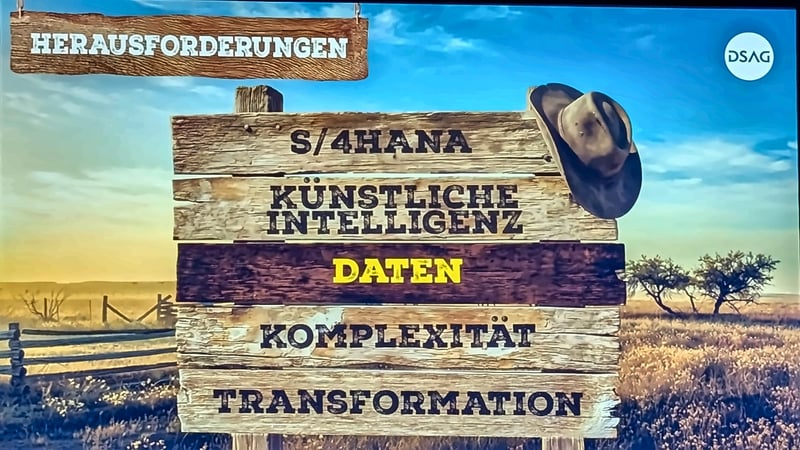
For us, the most important demands were those on AI and data. On AI, DSAG asks for lower barriers to entry, economic value before vision and above all no coupling of AI usage to cloud contracts. That runs fairly directly against SAP's current line of offering Joule and its agents only in the cloud. On data, DSAG demanded "product maturity instead of announcement density", along with reliable roadmaps, transparent licensing models and integration into existing architectures. The acquisitions of Prior Labs, Reltio and Dremio give this demand additional weight, and Hungershausen explicitly asked SAP to explain where they fit. The new products are likely to change quite a bit in Business Data Cloud once again, the only open question is what exactly. That is why we are looking forward to SAP TechEd in Berlin from 27 to 29 October, where we expect further announcements.
In the SAP keynote, Thomas Pfiester answered DSAG's demand for a clear roadmap with an individual path into the Autonomous Enterprise. SAP wants to analyse each customer's current SAP footprint together with them and take them along the North Star Architecture, supported by seven announced migration assistants, for example for custom code, data migration and testing. A big promise, but without real surprises or news compared to Sapphire. What role Business Data Cloud plays on this path, the keynote did not say.
The Knowledge Core, where SAP Business Data Cloud finds its role
Hagen Jander brought a little more clarity in the afternoon. His starting point was the context gap.
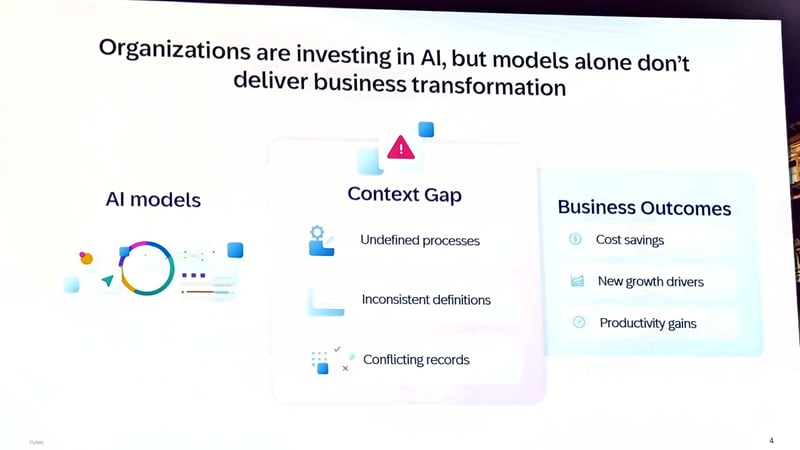
Companies are investing in AI, but between the model and the business outcome there are undefined processes, inconsistent KPI definitions and conflicting records. Anyone with a BW background knows the problem well, when three systems hold three versions of the same customer and nobody can say which one is the leading one. An agent built on top of that can only be as good as the context it receives.
SAP's answer is called the Knowledge Core. It stands for the business knowledge agents need to work reliably. It brings together semantics, the Knowledge Graph, data products, AI domain models, analytics and unified master data. The corresponding diagram reappeared an hour later in the planning session, so it is likely to become SAP's new standard picture.
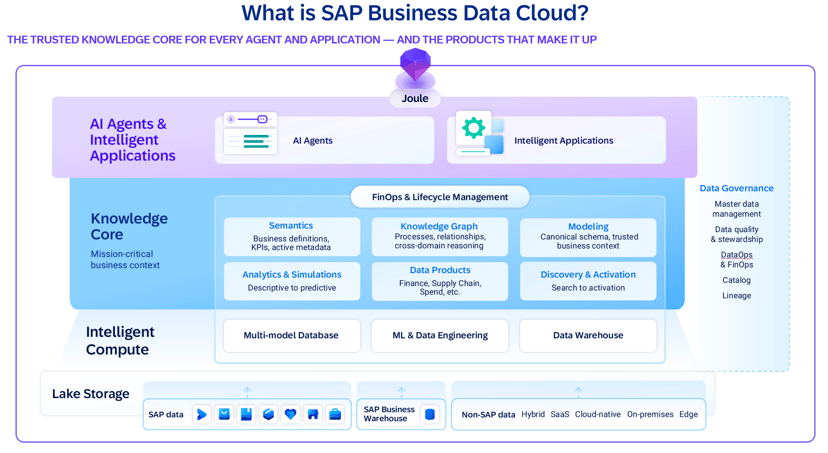
What we find interesting is that the Knowledge Graph is now just one building block among several. A year ago it stood alone at the centre. SAP has evidently understood that a graph on its own is not enough to make agents work reliably. That matches our own experience. In our projects where we work agentically with SAP data and analytics, context engineering and context management always come first, before agents take over workflows. We describe two examples in our article Agentic AI in Practice.
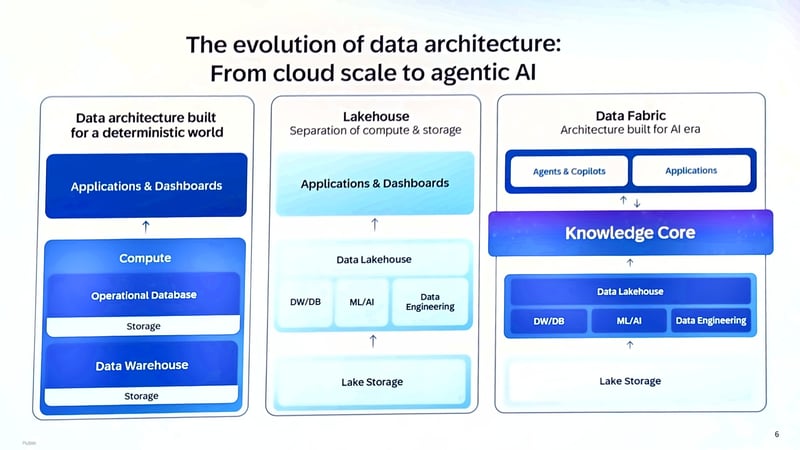
How the Knowledge Core will materialise in concrete terms remains open, though. Is it a product of its own, a layer in BDC or mostly a new umbrella term for building blocks that partly exist already? SAP also positions the Knowledge Core as the central layer of the next evolutionary stage, from lakehouse to data fabric. That is a bold move, considering that SAP has only just set out on the road to a true lakehouse with BDC, and that in practice, whether with BW or Datasphere, you still mostly find classic data warehouse approaches.
In this context, Jander also explained the acquisitions of Reltio and Dremio. Reltio is meant to unify master data beyond SAP and monitor its quality, closely integrated with SAP Master Data Governance. Dremio mainly brings Iceberg integration and data federation. As a Dremio partner, we are particularly interested in how this fits SAP's previous BDC strategy. BDC started with Delta Lake and BDC Connect based on Delta Sharing, first with Databricks, today also with Snowflake and Google BigQuery, with Microsoft Fabric and AWS set to follow in early 2027. With Dremio, SAP is now betting on Apache Iceberg as its table format. It remains open whether this will be a real break with Delta, how much BDC as a lakehouse platform will still change as a result, and what it means for everyone who has already started with the object store in Datasphere.
Get our presentation "Agentic Development with SAP BW"
BW modernisation, SAP's tools and our path with MCP servers
For many of our customers, BW modernisation was the most important topic of day one. SAP names the dilemma itself. Nobody is going to throw away their BW tomorrow, but it does not meet the requirements of a future data platform either. SAP's strategy is BW PCE in BDC as a first step to make BW interoperable. For customers on BW 7.5 this is also a way to buy time, because with BW PCE maintenance runs until 2033.
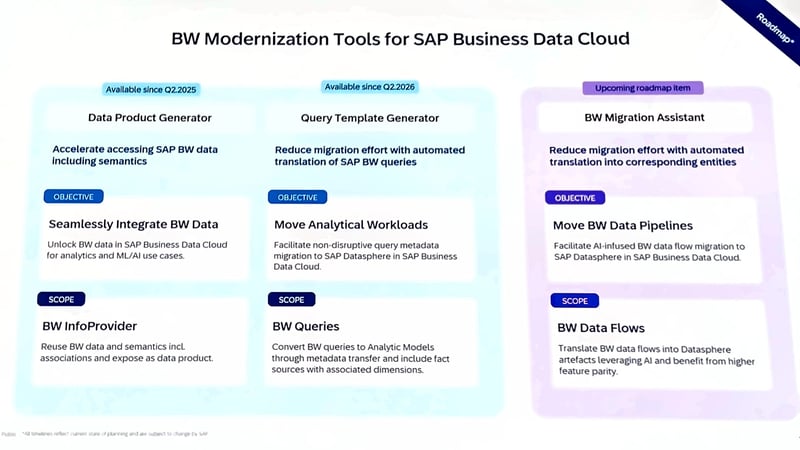
Customers who have moved to BW PCE get two deterministic tools for the next steps today, the Data Product Generator and the Query Template Generator. An AI-based BW Migration Assistant, which is meant to move entire data flows to Datasphere, is on the roadmap as an announcement.
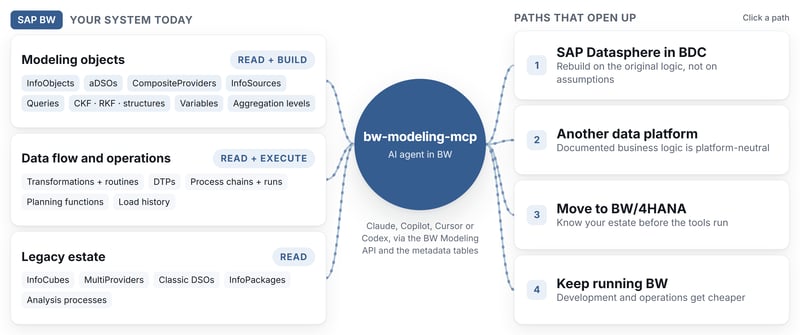
We are convinced that a lot more is already possible today, without PCE and without buying additional tools. The BW Modeling MCP Server is an open source project we developed, and it is already in use with customers. An AI agent that can not only read everything in BW, right down to transformations, routines and legacy objects, but can also develop there itself, opens up entirely new possibilities. The paths become much wider, and modernisation becomes a real choice of your own strategy. Find out more on our page Agentic AI for SAP BW and in our presentation Agentic development with SAP BW.
Our trade show game, a playful way to experience agentic AI in SAP data and analytics
We showed how far this already goes at our booth, in a playful way. For the congress we built a small Western arcade game that picks up the DSAG motto. In DATA DRIVE, scattered source systems roam the prairie for 60 seconds, from Excel sprawl through data silos to the legacy colossus, and the player catches them and migrates them into the harmonised data platform.
The really exciting part starts after the game, though, and so does the story of how it was built. Every result flows through a workflow in n8n into our SAP BW, and a dashboard in Claude reads it live through the BW Modeling MCP Server. Every player immediately sees their result, their ranking and how cleverly they played compared to everyone else.
None of this was developed manually. Starting from a business specification, an AI agent built the game, the n8n workflow and, through the BW Modeling MCP Server, the complete BW model including queries and key figures. That is agentic data engineering, spec-driven from requirement to activated object. The dashboard was created agentically as well, from business questions about meaningful KPIs and how to present them, and shows what agentic analytics means. On our side, the MCP server runs centrally on SAP BTP and accesses our demo system with principal propagation, exactly as it would be possible in productive customer environments.
Planning becomes a decision platform
In a joint session with Jie Deng, Kristian Rümmelin showed where SAP wants to take planning. He described planning as forming the will for the future. For something that is often complex and lengthy in practice, a refreshingly simple definition that stuck with us. That is exactly where the platform is meant to go, becoming a decision management platform on which agents plan and people decide. With Joule, a first set of agents is coming to SAP Analytics Cloud.
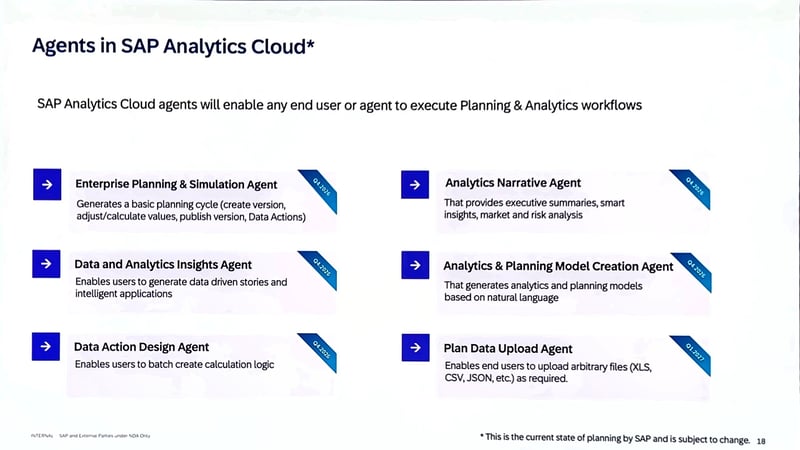
SAP is clearly moving forward on planning. Agents like these can speed up planning projects massively and make it much easier to build a planning solution exactly the way it is needed. Teams can focus on what creates value and worry less about how data actions work technically underneath. How well this will work remains to be seen, especially in complex planning scenarios, which are the rule rather than the exception. Another open question is who will be able to use the agents, because as Joule features they are not basic features that everyone simply has. To close, Rümmelin had an agent build a complete planning story.
Jie Deng picked up from there and showed where SAP wants to take stories and dashboarding. SAC stories can be created not only through Joule agents but also directly in SAC with the Story Wizard, and what is new is that it can generate an HTML5 page instead of a classic story. The widgets inside remain SAC widgets, but the layout around them is open HTML5. That makes it fairly clear which way the wind is blowing. Joule Work can generate HTML5 pages too, and story and dashboard generation, just like talking to your own data, is likely to happen there more and more in the future. It shows how much SAP Analytics Cloud is changing with AI and Joule right now. There is one catch, though, the SAC Story Wizard currently only works with SAC models, not with live models on Datasphere or BW queries.
On Wednesday, the session “SAP Business Data Cloud 360°” by Jie Deng and Maximilian Gander took this one step further. In the planning demo, a workflow in n8n starts after the month-end close, pulls actuals and budget from SAP Analytics Cloud and SAP Datasphere, and creates a flash forecast whenever a variance exceeds the threshold. An agent connected to SAC via MCP alerts controlling by email and Teams, while the planning story explains the root cause and suggests ways back to budget. The planner then describes the planned measures in Joule in plain language, and Joule writes the values into the forecast version. Every step stays traceable in the version history, and nothing is published until a human approves it. It is no coincidence that n8n shows up here, since SAP took a stake in n8n in May and is embedding the platform into Joule Studio. We still especially enjoyed the demo, because our trade show game runs on the same building blocks, with n8n for the workflow and MCP as the gateway into the SAP system.
SAP also showed what comes next for Seamless Planning. Data is set to flow from Datasphere directly into planning models via task chains, which simplifies exactly the scenario from our article SAP Seamless Planning, three ways to integrate external data. On top of that come tools for moving existing planning solutions to Seamless Planning, which should lower the barrier to switching considerably for many SAC customers.
Our presentation, data mesh with S/4HANA in practice
Our own presentation on Wednesday evening came out of an ongoing project at DEGES. Dr. Rene-Reiner Starke and Joschka Kuhrt showed how DEGES is introducing a data mesh in parallel with its S/4HANA transformation. The starting point was a heterogeneous system landscape in which neither data flows nor responsibilities nor the business-critical data objects were transparent.
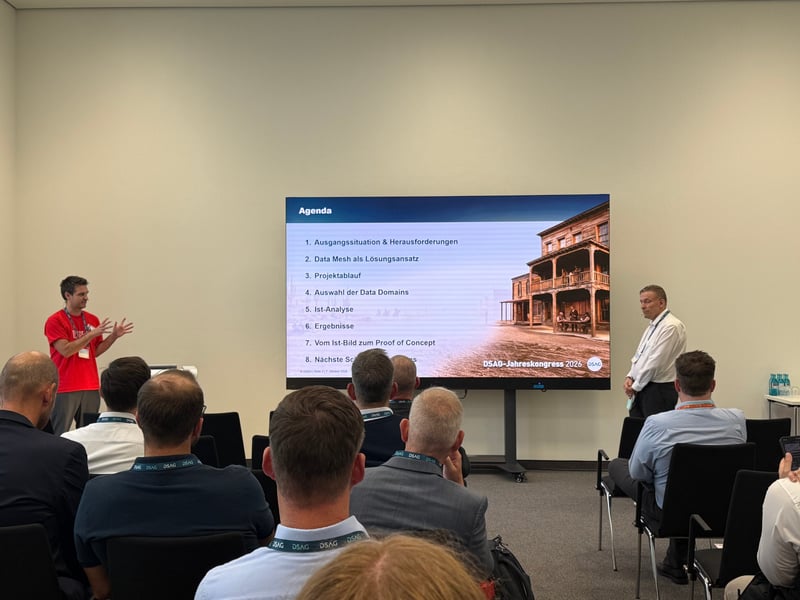
The project is built on three building blocks. In data domains, the business units take responsibility for their data, a modern data hub brings it together technically, and a data catalog makes visible what exists and who owns it. The project started with two business-critical domains in which the business units defined and described their data products themselves. On this foundation, the new data platform and the data catalog are now being introduced.
This closes a circle back to the beginning of the congress. What Jander described as the context gap, meaning inconsistent definitions, conflicting records and unclear responsibility, is exactly what DEGES is working on, just from the business side. Documented data products with clear ownership are the context an agent will later need to work reliably. Anyone introducing a data mesh today is also laying the foundation for agentic AI.
What we take away from Cologne
SAP's direction is clear, the Autonomous Enterprise is meant to run on agents. BDC plays a part in this as a data layer meant to provide agents with context, above all where data comes together across applications and beyond SAP. How central it will ultimately become is still open, and much of it is still an announcement, from the Migration Assistant to the question of what Dremio and Iceberg mean for BDC. DSAG's demand for product maturity instead of announcement density therefore remains relevant.
The common thread across all three days was context. Agents are only as good as the knowledge you give them, whether in planning, in data engineering or in agentic analytics, when business users talk to their data. Anyone who builds clean responsibilities, definitions and metadata today creates the foundation on which agents can work reliably.
The conversations at our booth were just as exciting as the sessions. Many of them revolved around introducing BDC and around how BDC and Databricks work together, whether anything has changed in the strategy and whether there is a clear best-practice path. For some BW customers it was also an eye-opener to see that agentic AI in BW already works today, live in our trade show game.
Would you like to know what these announcements mean for your BW, Datasphere or SAC landscape, or what a first agent on your own data could look like? Get in touch, we will support you from the initial assessment to productive use.