Skip to content
NextLytics
Megamenü_2023_Über-uns

Shaping Business Intelligence

Whether clever add-on products for SAP BI, development of meaningful dashboards or implementation of AI-based applications - we shape the future of Business Intelligence together with you. 

Megamenü_2023_Über-uns_1

About us

As a partner with deep process know-how, knowledge of the latest SAP technologies as well as high social competence and many years of project experience, we shape the future of Business Intelligence in your company too.

Megamenü_2023_Methodik

Our Methodology

The mixture of classic waterfall model and agile methodology guarantees our projects a high level of efficiency and satisfaction on both sides. Learn more about our project approach.

Products
Megamenü_2023_NextTables

NextTables

Edit data in SAP BW out of the box: NextTables makes editing tables easier, faster and more intuitive, whether you use SAP BW on HANA, SAP S/4HANA or SAP BW 4/HANA.

Megamenü_2023_Connector

NextLytics Connectors

The increasing automation of processes requires the connectivity of IT systems. NextLytics Connectors allow you to connect your SAP ecosystem with various open-source technologies.

IT-Services
Megamenü_2023_Data-Science

Data Science & Engineering

Ready for the future? As a strong partner, we will support you in the design, implementation and optimization of your AI application.

Megamenü_2023_Planning

SAP Planning

We design new planning applications using SAP BPC Embedded, IP or SAC Planning which create added value for your company.

Megamenü_2023_Dashboarding

Business Intelligence

We help you with our expertise to create meaningful dashboards based on Tableau, Power BI, SAP Analytics Cloud or SAP Lumira. 

Megamenü_2023_Data-Warehouse-1

SAP Data Warehouse

Are you planning a migration to SAP HANA? We show you the challenges and which advantages a migration provides.

Business Analytics
Megamenü_2023_Procurement

Procurement Analytics

Transparent and valid figures are important, especially in companies with a decentralized structure. SAP Procurement Analytics allows you to evaluate SAP ERP data in SAP BI.

Megamenü_2023_Reporting

SAP HR Reporting & Analytics

With our standard model for reporting from SAP HCM with SAP BW, you accelerate business activities and make data from various systems available centrally and validly.

Megamenü_2023_Dataquality

Data Quality Management

In times of Big Data and IoT, maintaining high data quality is of the utmost importance. With our Data Quality Management (DQM) solution, you always keep the overview.

Career
Megamenü_2023_Karriere-2b

Working at NextLytics

If you would like to work with pleasure and don't want to miss out on your professional and personal development, we are the right choice for you!

Megamenü_2023_Karriere-1

Senior

Time for a change? Take your next professional step and work with us to shape innovation and growth in an exciting business environment!

Megamenü_2023_Karriere-5

Junior

Enough of grey theory - time to get to know the colourful reality! Start your working life with us and enjoy your work with interesting projects.

Megamenü_2023_Karriere-4-1

Students

You don't just want to study theory, but also want to experience it in practice? Check out theory and practice with us and experience where the differences are made.

Megamenü_2023_Karriere-3

Jobs

You can find all open vacancies here. Look around and submit your application - we look forward to it! If there is no matching position, please send us your unsolicited application.

Blog
NextLytics Newsletter
Subscribe for our monthly newsletter:
Sign up for newsletter
 

The Agentic Turn in Data Engineering: Why Architecture Still Leads

In a previous article we built an AI agent inside Databricks that reads your data, reasons about it, and hands back recommendations you can act on. That piece was about how to stand one up. This one is about the question that shows up the morning after: where does an agent actually earn its place across the data engineering workflow, and what decides whether it helps or just makes a mess faster?

Picture the second case. An agent opens a pull request overnight. It has refactored a transformation and added a passing test, and the description reads well. It has also renamed a column to customer_id in a model where every neighbouring table has called it cust_key for three years. Nobody told the agent that convention existed. Nothing in the diff is broken. It still doesn't belong in your platform, and a reviewer now has to notice that before it merges. Multiply that across a week of agent-generated changes and the shape of the problem is clear.

What Is AI Agentic Automation? Moving Beyond Autocomplete

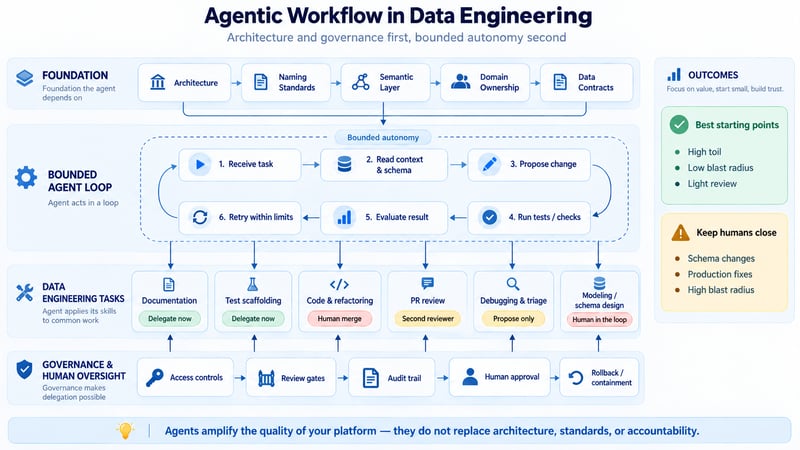
The useful line to draw runs between a single model call and an agent. A single call takes a prompt and returns text (a completion, a summary, an answer in a chat window) and then waits for you. An agent runs a loop instead. It can read a schema, propose a change, run the test against that change, and use the failure it gets back to try a different approach, calling tools and acting across systems until it reaches something it treats as finished.

That loop is what makes agents useful for data work. It also means an unbounded agent will eventually act somewhere you didn't want it to, so the version that holds up in production is a bounded one: the agent does the multi-step grind inside limits you set, and a human signs off at the points that matter.

Top Use Cases for AI Engineering Agents in Software Development

Across a typical data engineering workflow, agents are already good at a recognisable band of tasks:

  • Documentation. Data dictionaries, column descriptions, lineage summaries, and runbook drafts that stay close to the code instead of rotting in a wiki.

  • Test and quality scaffolding. Turning expectations into a first draft of test cases, anomaly checks, and validation rules: a starting point an engineer sharpens, not the final word.

  • Coding and refactoring. Generating transformation logic, translating between SQL dialects, and mechanical refactors across a lot of files at once.

  • Review. A first pass over a diff that flags anti-patterns, style drift, and obvious performance or governance concerns before a human reviewer spends attention on it.

  • Debugging and triage. Reading logs, tracing a failure back to its cause, and proposing a fix for a person to approve.

  • Modeling. Profiling a source and proposing a schema, a normalization choice, or a first-cut dimensional design.
Typical_Data_Engineering_Workflow

These tasks are not equal, though. Documentation and test scaffolding are cheap to check and hard to break; if a dictionary entry comes out wrong, someone corrects it and little else happens. A schema change or a production fix carries real downside: the toil it removes is high, but a bad one propagates before anyone notices. Where a task sits on that spectrum, far more than how impressive the agent looks doing it, is what should decide how much rope you give it.

Task Toil it removes Blast radius if wrong Delegate now?
Documentation High Low Yes, review lightly
Test scaffolding High Low Yes, an engineer curates
Code refactor / dialect translation High Medium Yes, with a human on the merge
PR review (first pass) Medium Low Yes, as a second reviewer, not the only one
Debugging / triage

High

Medium Propose only, human approves the fix
Data modeling / schema change High Low Human-in-the-loop, always

Watch the recording of our webinar "Bridging Business and Analytics: The Plug-and-Play future of Data Platforms"
Why Context and System Architecture Control AI Agent Performance

An agent is only as coherent as the context it works from, and on a data platform most of that context is the architecture. Naming conventions, modeling standards, a semantic layer that pins down what "revenue" actually means, an owner for each domain: those are what let an agent produce something that fits the rest of the platform instead of being merely correct on its own terms. Take that structure away and the agent still produces something. It produces confident output that reads fine in isolation and quietly disagrees with everything around it: the renamed column, the metric computed a fourth different way, the table normalized in a model where three others denormalized it on purpose. Each change looks reasonable on its own. Together they are technical debt, arriving faster than a team of people could have written it. This is why "an agent will clean up our messy platform" has the causation backwards: an agent consumes structure, it can't manufacture it. Hand one a well-modeled, well-governed platform and it compounds good engineering. Give it an inconsistent starting point and you get that inconsistency back at scale, which costs more to unwind later than getting the foundation right would have cost up front.

Best Practices for AI Governance, Guardrails and Human-in-the-Loop Delegation

You can only delegate a task you are able to check, contain, and undo, which is exactly why governance, so often treated as a brake on agents, is what actually lets you hand them real work. Access controls bound what an agent can reach. Data contracts hand it stable definitions to build against. Review gates stop plausible-but-wrong output before it lands, and when something does slip through, an audit trail and clear domain ownership tell you what changed and who answers for it. A team that trusts those boundaries can delegate more to agents, precisely because it knows where the edges are. That is also why the sensible rollout follows the blast radius. Begin where the toil is high and the downside is low (documentation, test scaffolding, first-pass review) and let agents run with a light human touch. Keep people firmly in the loop on modeling and anything that reaches production. Measure the impact instead of assuming it, then widen an agent's autonomy as your guardrails and your trust in them mature. If you cannot yet check an agent's output on a given task quickly and reliably, that task is not ready to hand over yet; more often than not, the thing blocking it is a gap in the foundation rather than a limit of the agent.

Moving towards Agentic Governance: Our Conclusion

Agentic AI is becoming a real layer on top of the modern data platform and the productivity gains are not hypothetical. But it works like a multiplier, and a multiplier only ever reflects what you give it: good engineering on a well-governed platform, and every existing inconsistency on a fragile one, both scaled up. The teams that get the most out of it won't necessarily be the earliest adopters, but the ones who did the unglamorous work first (the architecture, the standards, the governance) and then let agents move faster on top of it. What agents change is the speed of the work, never the question of who is accountable for deciding what "good" looks like in the first place.

If you would like an outside perspective on whether your data platform is in shape to delegate to agents safely, we would be glad to talk it through with you.


 

FAQ - Agentic AI in Data Engineering

Here you will find some of the most frequently asked questions about the Agentic Turn in Data Engineering.

What is the difference between the AI assistants we already use and an agent? The mechanical answer is that an assistant responds to one request and stops, while an agent plans, uses tools, and acts across systems until it reaches a goal. The difference that matters for a data team is where the mistakes end up. A wrong answer from an assistant sits in a chat window until you decide what to do with it. A wrong action from an agent has already touched a table, a pipeline, or a pull request. That is why the useful question about an agent is less "how capable is it" and more "what is it allowed to reach".
I don't have a mature semantic layer or naming standards yet. Should I wait before using agents at all? Start, but start where your existing work is already good. If one domain is well modeled and consistently named, point the agent there first, for documentation or test scaffolding, because it has a clean example to take its cues from. The corners where your standards are thin are exactly where an agent will produce its most convincing wrong answers, so those are the last to hand over, not the first. Let the rollout track your foundation, domain by domain.
Will code review by an agent replace human reviewers? Treat it as a first pass, not a verdict. An agent is good at catching mechanical issues (style drift, obvious anti-patterns, a query that will clearly scan too much) before a person looks. What it cannot reliably judge is whether a change fits your architecture and your business intent, which is the part human review exists for. Used well, it means your reviewers spend their attention on the judgement calls instead of the missing semicolons.
Is governance going to slow agent adoption down? It tends to be the thing that lets adoption happen safely. Try to answer a concrete question, "which agent changed this table last quarter, and on whose authority?", without access controls and an audit trail, and you will find you cannot let agents near anything that matters. The teams that delegate the most tend to be the ones that invested in governance early, because they can trust what the agent is and isn't permitted to do.
How do I know whether AI agents are actually helping? Watch where the effort moves, not how much output appears. The number to trust is how often agent output is accepted without rework: when it is low, people are spending their saved time correcting the agent. Time-to-review and incident rates are worth tracking alongside it. A high volume of agent-generated changes with a low acceptance rate is not productivity: it usually means the context the agent has to work from is too thin for the task you gave it.
Which agent or tool should I standardise on? Less rides on this than vendors would like you to think, because the plan-call-tools-act capability is becoming common across the major platforms and open frameworks. When you do choose, weigh the things that touch your foundation: how well it respects your access controls, how legible its actions are after the fact, and how cleanly it fits your existing catalog and review process. Those decide whether the agent works within your governance or around it, which matters more than any benchmark score.

,

avatar

Apostolos

Apostolos has been a Data Engineering Consultant for NextLytics AG since 2022. He holds experience in research projects regarding deep learning methodologies and their applications in Fintech, as well as background in backend development. In his spare time he enjoys playing the guitar and stay up to date with the latest news on technology and economics.

Got a question about this blog?
Ask Apostolos

The Agentic Turn in Data Engineering: Why Architecture Still Leads
7:33

Blog - NextLytics AG 

Welcome to our blog. In this section we regularly report on news and background information on topics such as SAP Business Intelligence (BI), SAP Dashboarding with Lumira Designer or SAP Analytics Cloud, Machine Learning with SAP BW, Data Science and Planning with SAP Business Planning and Consolidation (BPC), SAP Integrated Planning (IP) and SAC Planning and much more.

Subscribe to our newsletter

Related Posts

Recent Posts