/Logo%202023%20final%20dunkelgrau.png?width=221&height=97&name=Logo%202023%20final%20dunkelgrau.png)



















Anyone dealing with SAP-based business planning is quickly faced with the question: Which solution is the right one? The options are diverse - from BW-based planning with BPC to hybrid approaches in which SAP Analytics Cloud (SAC) meets classic backend technologies as a front end, through to native planning directly in SAC.
Our Blog series: Focus on Seamless Planning |
| 1 Spotlight on seamless planning: SAC planning meets SAP Datasphere |
| 2 SAP Seamless Planning: Three Ways to Integrate External Data |
Evolution of SAP Planning
Traditionally, SAP planning is closely linked to the Data & Analytics area. Over the years, numerous solutions have emerged that were either more application-centric (application-driven) or more data-driven (data-driven) with a focus on integration and backend performance. SAP BPC Embedded combined the strengths of front-end-oriented BPC planning with the robust integration of BW-IP and the in-memory technology of HANA (PAK). This embedded model, often referred to as the best of both worlds, still offers a powerful and stable solution for corporate planning today. However, the further development of SAP planning is focusing on integrated, cloud-based architectures.
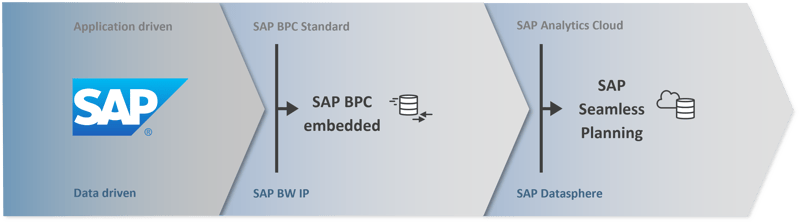
With SAP Cloud for Planning, SAP launched the first pure cloud planning solution on the market in 2015 - the starting signal for today's SAC. The cloud-first strategy quickly made it clear that the future of SAP planning lies in SAC, while BPC-based planning is becoming less important. But is SAC the right choice for all of your scenarios?
Many companies are faced with exactly this question. Because although SAC planning offers many advantages, there are key challenges:
-
Data integration: cloud data models require complex replication.
-
Planning logic and calculations: The flexibility of ABAP or AMDP-based functions cannot be mapped 1:1 in SAC, which makes complex logic more difficult.
-
Data volume & performance: Large data volumes push SAC to its limits.
This is why many companies continue to rely on SAP BPC, especially for complex planning, and have not yet made the complete switch to SAC.
Seamless Planning brings the essential change.
Seamless Planning explained: More than just integration?
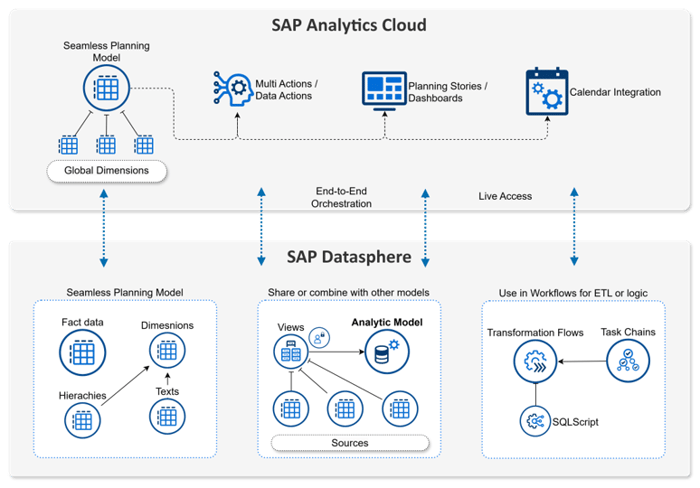
What exactly is behind Seamless Planning - and why will it make a significant impact on corporate planning? It is important to understand that Seamless Planning is not a new stand-alone planning solution and does not replace SAC Planning. Rather, it extends it with SAP Datasphere as a powerful storage and processing platform, without restricting the previous functional scope of SAC planning. Predictive scenarios, commenting and all familiar SAC planning functions can still be used without restriction. But what does this actually mean?
Data storage in SAP Datasphere
Planning data and public dimensions are stored directly in SAP Datasphere – together with all other company data. This means that they are in the right place and can be used for other purposes in real time, without the need for complex data replication.
Optimized resource control and monitoring
Since both data storage and processing now take place on Datasphere, companies can control and adjust CPU and memory resources in a much more targeted way – a capability that did not exist in SAC. The advantage: unified control of reporting and planning within Datasphere, enabling efficient monitoring and scaling of resources.
Use Datasphere tools in planning
Thanks to seamless integration with SAP Datasphere, its technology stack is now also available for the planning process. Companies can link plan data live with other data sources – for example, for cross-departmental synchronization in planning. ETL processes for data preparation or the calculation of complex planning logics can be integrated into end-to-end workflows: SAC can trigger actions in Datasphere and vice versa. This opens up completely new possibilities for designing planning processes – whether within SAC, in Datasphere or in a combination of both. While the Q1 release lays the central foundations, this interplay will be further expanded, especially with future extensions. The powerful Datasphere tools should therefore be actively incorporated into the design and implementation of planning processes in order to make optimal use of synergies in planning.
Case study NextJuice: A glimpse into the future of planning
Using a practical example, we demonstrate how seamless planning enables the seamless integration of additional external data into the planning process.
In our demo, the beverage retailer NextJuice wants to create a forecast for sales controlling and uses the previous year's sales figures as a basis. In addition, planned discount campaigns that have already been prepared elsewhere should automatically be incorporated into the planning process in order to calculate more realistic sales targets.
Thanks to Seamless Planning, such external additional data, which may be available as local tables in other Datsphere spaces, can be linked directly to the planning data and included in the planning dashboard. To enable the business department to maintain the additional data independently, we use our product NextTables – an intuitive self-service solution that is ideally suited as a supplement to Seamless Planning.
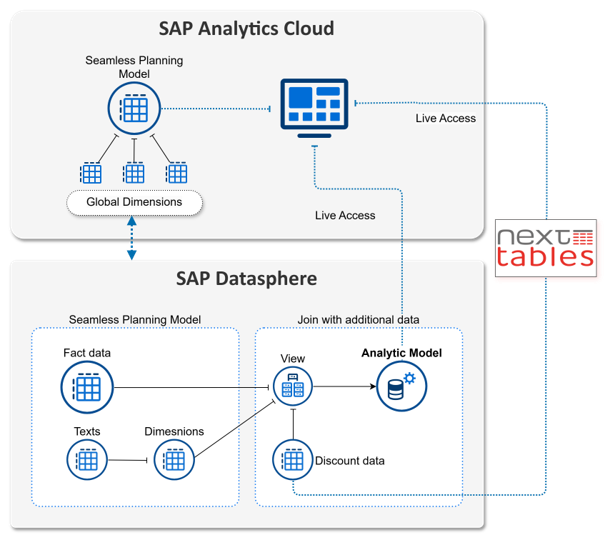
Our advanced seamless planning model uses an SQL view to link the planning data with the discount data, which has a completely different structure. This is where the strength of Datasphere comes into play: the powerful SQL views allow data to be flexibly enriched both graphically and code-based and merged according to individual business logic. An analytic model is used to provide the data prepared in this way for the planning dashboard.
The added value is immediately apparent in the analysis results: Before the discounts were taken into account, the planning result showed a positive development of the total margin. However, immediately after the discount data was incorporated, a different picture emerged, making it necessary to adjust the planning.
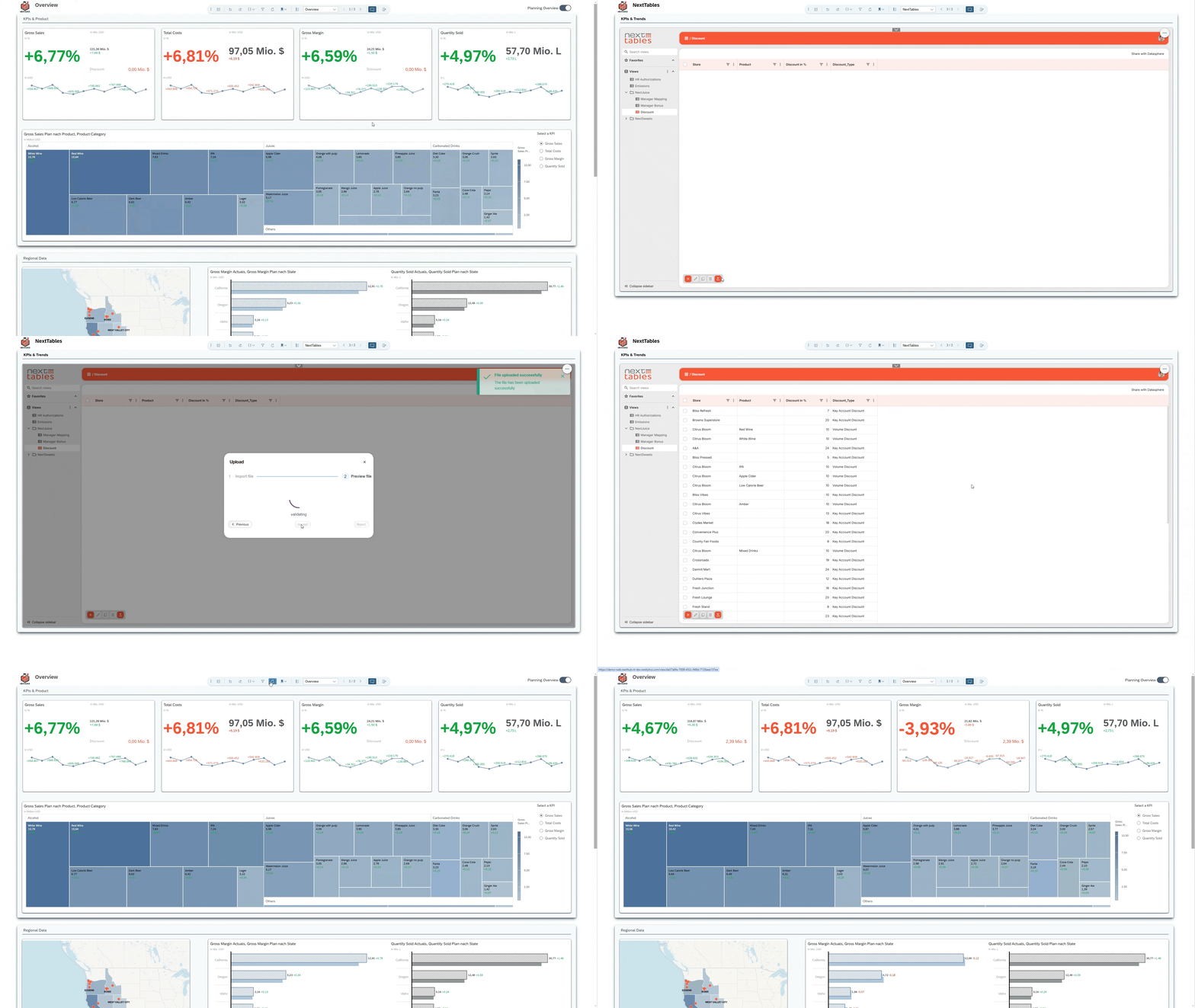
In this specific example, we have shown how the seamless integration of such additional data makes it possible to take external conditions into account immediately in the planning process, enabling a targeted response.
New features, new possibilities: What’s coming next
While the central foundations for seamless planning were created with the Q1 release, many of the functions that fully realize the added value of this integration are still on the roadmap. In our view, the following planned features are highly promising:
Reuse of Datasphere dimensions
With the upcoming enhancements, it will be possible to use dimensions from Datasphere directly in SAC models without having to define them in the SAC. This reduces maintenance effort and ensures that consistent structures are used for planning and reporting.
Live consumption of data from SAP Datasphere
Currently, data from SAP Datasphere must be replicated in SAC models to use it for planning. This will continue to be the case with the Q1 release, even if the data is stored in Datasphere – for example, for actuals data to be displayed in planning tables or used in data actions. In the future, fact data from Datasphere should be able to be linked directly and without replication in SAC planning models as external versions – technically comparable to a union. This allows actuals data or plan data from other company areas to be linked live without having to create separate views in Datasphere. From the SAC planning perspective, an external version behaves as if it were directly included in the planning model: it can be displayed in planning tables and used in data actions. This makes planning much more flexible, as real-time data from Datasphere can be taken into account immediately.
Cross-orchestration between SAC and Datasphere
With this planned feature, Seamless Planning will be extended to include deeper integration between SAC and Datasphere, enabling processes to be orchestrated across both systems. In the future, it will be possible to integrate task chains from Datasphere directly into SAC Multi Actions. A new task chain step is provided for this purpose in Multi Actions. It should also be possible to trigger specific planning steps in SAC from Datasphere. This makes it possible to coordinate complex planning processes across both platforms and provides the flexibility to implement planning steps where they are most useful – in SAC, in Datasphere or in a combination of both.
Write into SAC models via transformation flows
Currently, the fact tables of the seamless planning model are read-only in Datasphere, so models and public dimensions must continue to be loaded via import processes. With this enhancement, it will be possible to fill the fact tables in Datasphere directly via transformation flows. While this is not primarily intended for loading actuals data from our point of view, since this can already be incorporated directly into planning via the planned live consumption, it opens up new possibilities for planning. These include, for example, the creation of planning versions in Datasphere, the mapping of complex planning logics or the enrichment of planning data with external information via SQLScript. This allows planning steps to be implemented directly in Datasphere as ETL processes, enabling some business logics to be mapped more flexibly and efficiently.
Use Case: Cross-system initialization of the planning process
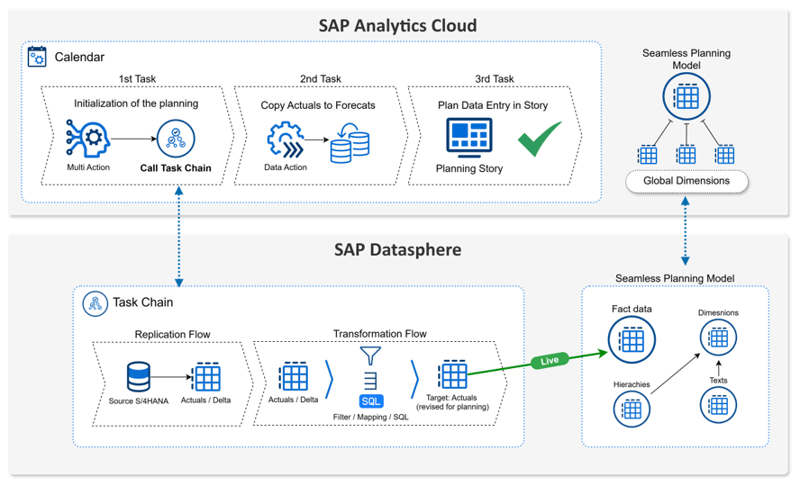
A specific example of the use of cross-orchestration and live consumption is the initialization of a planning process with the latest actual data. The process begins with a multi-action in the SAC calendar that starts the planning process:
-
The multi-action triggers a task chain in Datasphere that loads and transforms the latest actual data. The actual data is directly linked to the SAC model, so no replication is required.
-
A data action in SAC copies the actual data directly into the planning to generate a forecast based on the current actual values.
-
The planning story is provided with the updated data so that the planner can access the latest values in real time.
Get started now or wait? The best time to switch
Seamless Planning is still in its initial stages and is constantly evolving – but when is the ideal time to make the switch? While the first functions are already available, crucial enhancements are still pending. Companies should now consider when and how they can best integrate Seamless Planning into their planning strategy.
If you are using BPC and your planning has not yet been converted to SAC due to its complexity, it is worth following upcoming developments closely. Analyze your existing BPC planning and identify the key functions that are important for a smooth migration. It may therefore make sense to time the switch based on the availability of these functions. The only information currently available from official SAP slides is “2025 and beyond”, although it has already been communicated that the live consumption will be one of the next available features – which we were able to see live demoed in the Controlled Release Program.
If you are already using SAC planning, the next step depends on your system environment. The prerequisite for Seamless Planning is an SAC environment on HANA Cloud. If your SAC tenant is already running on HANA Cloud, you can use Seamless Planning immediately. If not, there are two options:
-
Wait for the upgrade of the existing SAC tenant
-
Provision a new SAC tenant on HANA Cloud
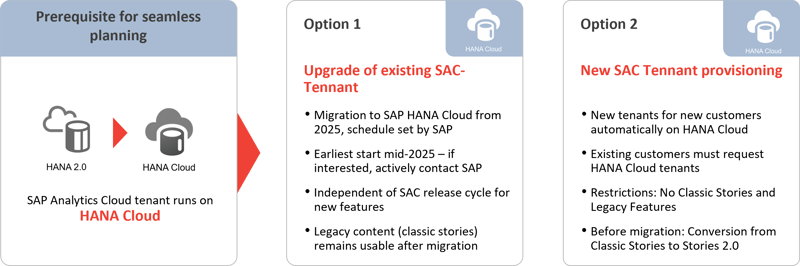
As SAP is working on a migration tool that can automatically convert existing import models into seamless planning models – with the exception of account models – companies can continue to use their existing SAC planning without having to worry about a high manual conversion effort later on.
The right time to start with seamless planning therefore depends on your current system landscape and planning requirements. Now is the right time to evaluate how seamless planning can optimize your planning strategy.
Do you have questions on this or another topic? Simply get in touch with us - we look forward to exchanging ideas with you!